With company growth comes greater operational complexity, where manual processes turn into constraints. They generate waste, increase expenses, and reduce speed. Maintaining competitiveness during scale-up requires the adoption of intelligent automation.
Intelligent automation applies AI to standard automation platforms, enabling automation of routine tasks as well as those involving judgment. This supports significantly larger workloads with lower error rates, higher quality output, and limited headcount growth. Success relies primarily on choosing the right technology partner.
Here is an evaluation of five leading intelligent automation providers for companies focused on rapid scaling.
Leading Intelligent Automation Companies to Know
When your business gets bigger, doing things manually starts slowing everything down. Choosing a good intelligent automation approach is one of the best ways to keep growing without major problems.
Below are five leading providers that support companies with their automation needs.
Avenga
Avenga Intelligent Automation Services is a global IT and digital transformation partner. Strategic insight combines with deep technical skill across a team of 6,000+ experts to engineer robust solutions for the world’s largest companies. These professionals design, develop, and manage custom digital platforms that scale to reach more than 200 million users, backed by three decades of market leadership.
Avenga works with businesses to address complicated business issues and convert them into practical solutions. They accomplish this primarily in areas such as automotive, finance, life sciences, and manufacturing, with a focus on scalable solutions that will be strong and relevant for years to come.
Services
- Strategy & Governance: Ensure automation supports main business objectives.
- Value Case & Roadmap: Prioritize high-return opportunities and outline growth path.
- Process Discovery: Mine logs and data to identify viable automation targets.
- Process Design: Refining workflows so they can support automation long-term.
- Technical Architecture: Creating modular integration layers that are simple to update.
- Testing & Deployment: Running tests in live-like environments and rolling out in phases.
- Managed Services: Offering ongoing monitoring and adjustments for consistent results.
- Cloud Integration: Securely connecting and scaling across cloud platforms.
UiPath
UiPath developed Robotic Process Automation (RPA) and evolved it into a full intelligent automation platform that covers complete business process transformation. The platform incorporates RPA along with AI features such as process mining and document understanding.
More than 10,000 organizations now use these capabilities to automate complex, multi-step workflows. You’ll find the solution running at major companies in banking, healthcare, and insurance. It works for both professional developers and business users, letting them build automations that boost efficiency and drive real operational improvements.
Services
- AI Document Understanding: Pulls and processes data from invoices, contracts, and forms.
- Process Mining & Task Capture: Analyzes workflows to find where automation delivers the most value.
- End-to-End Automation Platform: Brings together test automation, task mining, and low-code tools.
- ML-Based Intelligent Automation: Uses machine learning to handle decisions in tasks that vary or get complex.
- Computer Vision UI Automation: Combines vision and NLP to interact with any application interface, just like a person would.
EPAM
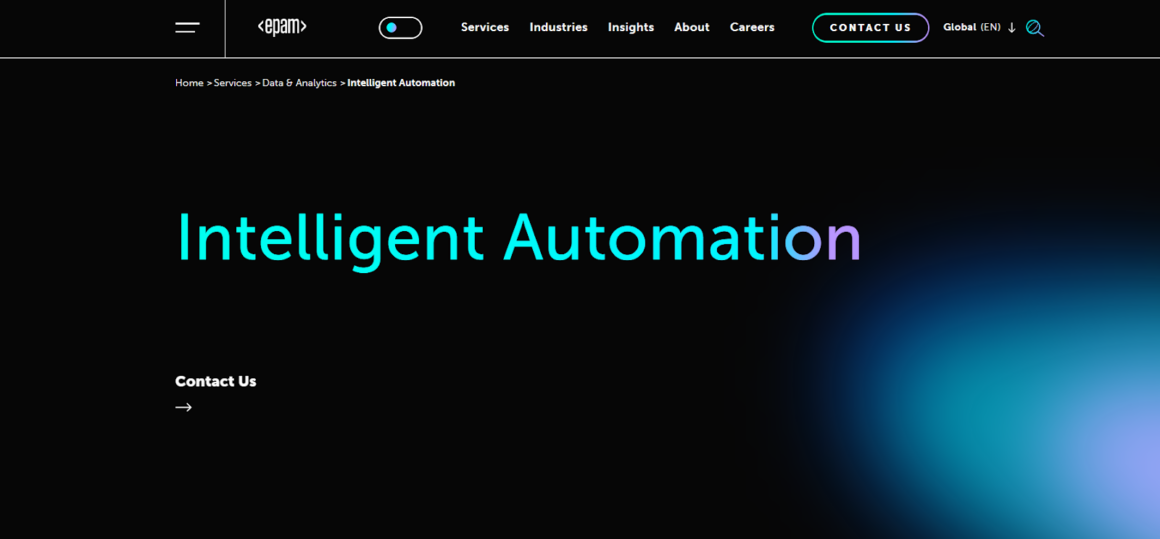
EPAM Systems is an engineering and consulting firm that builds custom software. They’re probably best known as the development partner behind several major automation platforms.
The company has over 700 certified automation developers and around a decade of business process experience to draw from. Their approach focuses on automation that works for people—helping employees rather than replacing them, improving efficiency, and making customer experiences better.
Services
- Holistic Automation Strategy: They build customized strategies from the ground up. No cookie-cutter templates. It’s all about what actually fits the business goals.
- Custom AI and ML Engineering: Machine learning, computer vision, NLP—whatever it takes to solve specific problems like fraud detection or market analysis.
- Robotic Process Automation (RPA): Taking manual work off people’s plates. Employee onboarding, applicant processing—tasks that used to take days get cut down to minutes.
- Process Intelligence & Optimization: Analytics that show you what’s working and what isn’t. Real-time insights, continuous tweaks, steady improvement.
- Vendor-Agnostic Expertise: They partner with 15+ RPA and automation vendors. No loyalty to any one tool—just whatever works best with the client’s existing stack.
Intellias
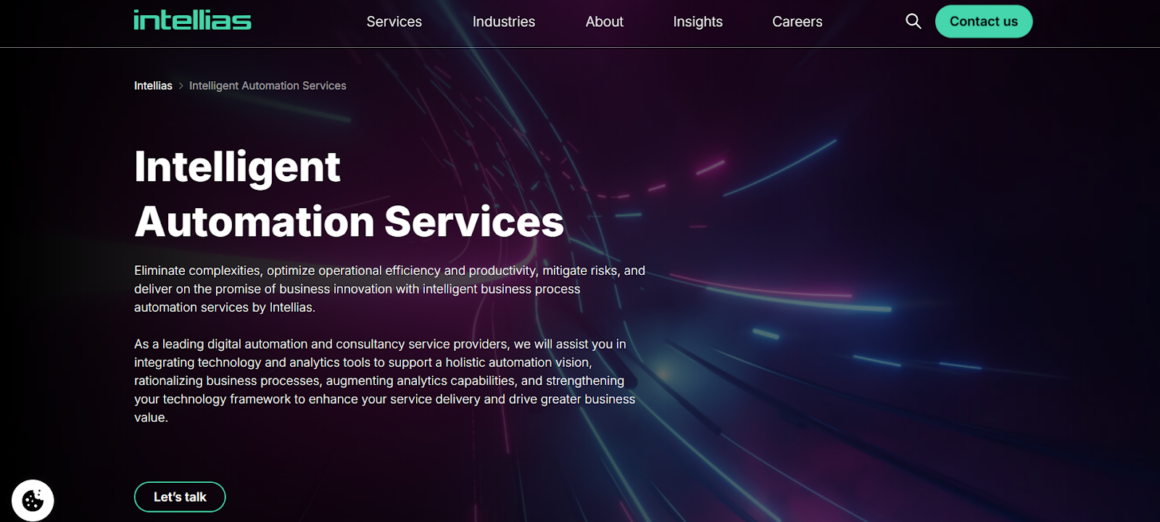
Intellias provides global technology services to support digital business operations. They have more than 20 years of experience and a team of engineers and specialists who partner with clients on challenges of any size, from planning to execution.
As experts in AI and product engineering, they offer practical digital transformation using smart automation to make systems more predictive and companies more stable.
Services
- Proof of Value (POV): Identify top opportunities + deliver custom end-to-end proof.
- Operational Model Consulting: Build optimal strategy, governance, and scaling model.
- Process Discovery: Assess, prioritize, and roadmap automation benefits.
- Scaled Delivery: Boost teams with expert engineers using Agile for fast scale.
- Support Center of Excellence: Ongoing guidance, change management, and optimization.
- Platform-Agnostic Toolkit: Combine Process Mining, IDP, RPA, iPaaS, and Conversational AI.
Automation Anywhere
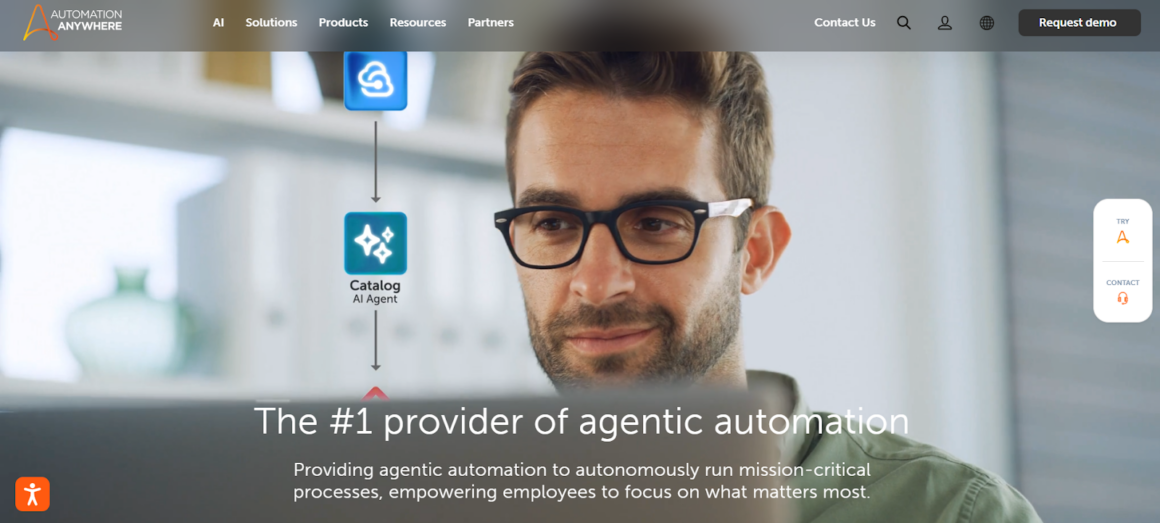
Automation Anywhere leads in cloud-native intelligent automation. It helps companies automate full business processes with a strong focus on scalability, security, and fast deployment.
The company uses a bot-as-a-service model and integrates generative AI to simplify and improve automation creation. Built for enterprises, it offers industry-specific tools and built-in analytics — especially useful for regulated sectors like finance and healthcare to increase efficiency, meet compliance, and speed up innovation.
Services
- Cloud-Native Bot-as-a-Service: Scalable, secure, rapid automation deployment.
- GenAI-Powered Automation: Natural language creation + intelligent co-pilot.
- IQ Bot: Advanced extraction from complex unstructured documents.
- Discovery Bot: Auto-identifies & prioritizes automation opportunities.
- Embedded Analytics: Real-time performance & business impact visibility.
- Enterprise Security & Compliance: Built for regulated industries.
What Is Intelligent Automation?
Intelligent Automation combines RPA with AI to run end-to-end business processes. The difference between this and traditional automation comes down to flexibility. Traditional tools stick strictly to preset rules, while IA uses systems that learn from data and adapt to variables along the way.
IA is composed of three core technologies:
- Robotic Process Automation (RPA): Automates repetitive, rule-based tasks (data entry, file moves, system interactions).
- Artificial Intelligence (AI): Enables predictive analysis (ML), text understanding (NLP), and image interpretation (computer vision).
- Process Mining: Analyzes system logs to map workflows and highlight top automation opportunities.
Evaluation Criteria Used in This List
When putting together this list, we focused on a handful of practical dimensions. Technical capability was the baseline—basically, how well each platform combines AI with core automation for actual business scenarios. We also considered their industry experience and whether they’ve handled complex, large-scale deployments.
Consulting depth mattered too, because some companies need help with strategy and governance, not just tools. And we looked at deployment flexibility, like cloud-native options and vendor-agnostic approaches for teams with existing setups.
These criteria make it easier to match providers to specific operational needs and growth plans.
Conclusion
Picking an intelligent automation partner is strategic. It determines efficient growth or ongoing issues.
Providers differ in tech strength, consulting depth, and rollout assistance. Full-service suits companies needing strategy, build, and management support. Platform-focused fits those wanting strong AI and pre-built elements.
Technical complexity calls for engineering and custom-build expertise. Flexibility needs vendor-agnostic partners. Cloud or large-scale fast deployment looks at architecture and speed.
The choice matches your operations, tech environment, and targets. Get it right, and automation produces measurable improvements and supports sustained success.