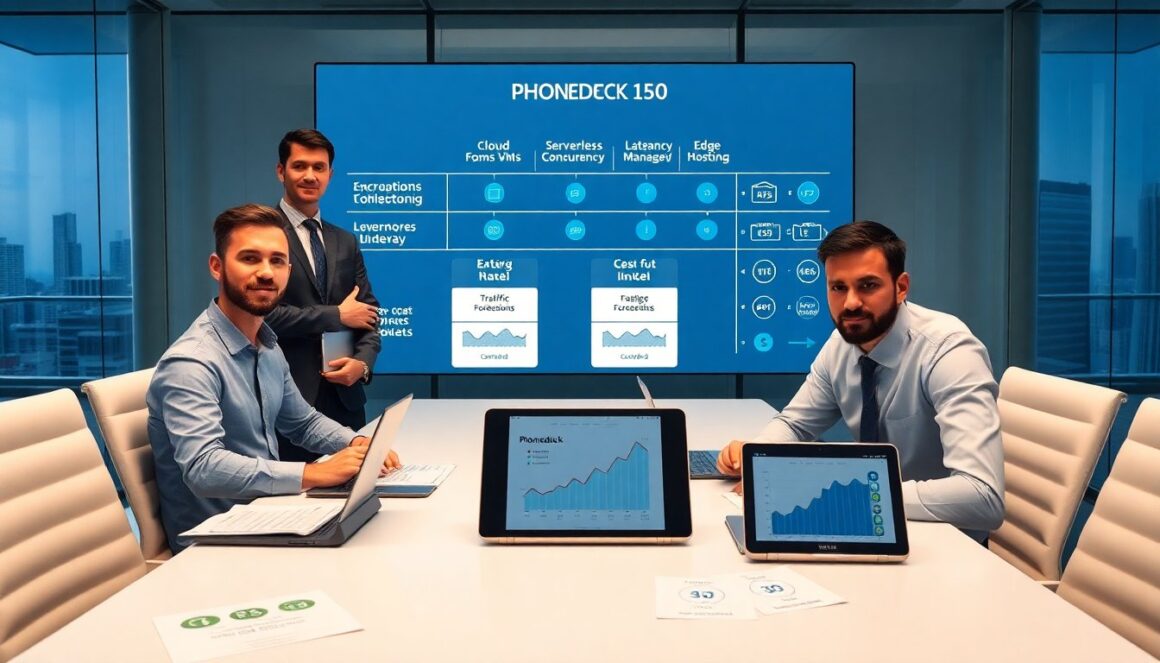
Choosing the hosting solution for your mobile app Phonedeck starts with clear requirements. The team must list traffic expectations, latency targets, concurrency, and data needs. The team must match those needs to hosting features. This guide helps the team decide between cloud, serverless, managed, and edge hosting for Phonedeck in 2026.
Key Takeaways
- Choosing the hosting solution for your mobile app Phonedeck starts with accurately assessing requirements like traffic, latency, concurrency, and data needs.
- Cloud VMs offer full control and predictable performance, ideal for specialized Phonedeck features requiring custom middleware or network setups.
- Serverless hosting enables automatic scaling for API backends and event processing but may have higher costs and cold-start latency under sustained loads.
- Managed hosting reduces operational overhead by handling scaling, backups, and patches, allowing Phonedeck teams to focus more on product development.
- Edge hosting decreases latency by running functions close to users, benefiting global audiences and latency-sensitive Phonedeck features.
- A hybrid hosting approach can balance control, cost, and speed by combining cloud, serverless, and edge solutions tailored to Phonedeck’s unique workflows.
Assess Your Phonedeck App Requirements
Phonedeck owners must define their goals before picking a host. They must state expected daily active users, peak session counts, and transaction rates. They must record acceptable latency numbers for voice, messaging, and sync operations. They must note data volume per month and retention rules.
Phonedeck teams must map features to resource needs. Real-time voice requires low-latency networking and stable jitter. Background sync demands reliable throughput and predictable I/O. Push notifications need timely delivery and a fast API gateway. Analytics and user logs require storage with query support.
Phonedeck architects must estimate cost drivers. Bandwidth charges rise with media use. Storage grows with logs and media files. Compute costs climb with real-time processing. They must model three scenarios: conservative growth, expected growth, and rapid growth. Each scenario should include monthly cost estimates and capacity limits.
Phonedeck teams must enforce security and compliance needs. They must list encryption requirements for data in transit and data at rest. They must record any regional data residency rules for user data. They must include authentication standards and audit logging needs. They must check provider certifications where required.
Phonedeck stakeholders must capture operational constraints. They must note team skill levels for infrastructure management. They must choose between full control and delegated management. They must identify SLA targets for uptime and recovery time. They must plan on monitoring, alerting, and incident response procedures.
Choose Between Cloud, Serverless, Managed, And Edge Hosting
Cloud virtual machines give Phonedeck full control of the stack. Teams get predictable performance and the option to run custom services. Teams must manage scaling, OS patches, and capacity planning. Cloud VMs suit apps that need specialized middleware, custom codecs, or specific network configurations.
Serverless platforms let Phonedeck scale functions automatically on demand. Teams avoid managing servers and pay for execution time. Serverless works well for API backends, event processing, and short-lived media tasks. Serverless can cost more at sustained high load. Teams must evaluate cold-start latency for real-time routes.
Managed hosting services provide operational support for Phonedeck. Providers handle scaling, backups, and security patches. Managed databases and media services reduce operational headcount. Managed options fit teams that want to focus on product features instead of infrastructure. Teams must compare SLAs, support tiers, and migration paths.
Edge hosting places runtime close to users and reduces latency for Phonedeck. Edge options help with static assets, caching API responses, and running lightweight functions near clients. Edge hosting suits global user bases and latency-sensitive features. Teams must check consistency models and limits on execution time at the edge.
Hybrid approaches can combine these options. Phonedeck can run real-time media on dedicated cloud instances, host APIs in serverless functions, and cache static assets at the edge. Teams must design clear boundaries between layers and choose a single auth and logging model.
Phonedeck teams must balance control, cost, and speed. They must consider team expertise and operational budget. They must pilot critical flows on a shortlist of providers and measure real user performance before committing.