Key Takeaways
- AI now drives both attack and defense, making it the defining force in security this year.
- The agentic SOC lets AI handle triage and early response as analysts supervise and approve.
- AI agents are a new identity frontier, and machine identities will outnumber human ones.
- Shadow AI, meaning unapproved tools and agents, is a top hidden risk for data and compliance.
- Just 6% of organizations report an advanced AI security strategy, despite 94% calling AI the top driver.
Why AI Now Defines Cyber Security
For years, AI was one tool among many. In 2026 it has become the ground the whole contest is fought on. Attackers use it to move faster and at greater scale, while defenders use it to see and respond faster in return. That makes grasping the role of AI in cyber security less a matter of curiosity than of competitive survival.
The shift shows up on both sides at once. The same models that help a team spot an intrusion in seconds also help an attacker write a flawless phishing lure. The trends below trace where that dual-use reality is heading. Read together, they point to one conclusion: AI is now infrastructure for security, not a feature bolted onto it.
|
Trend |
What it means for 2026 |
|
AI-powered offense and defense |
Attackers and defenders both weaponize AI, raising speed on every front |
|
The agentic SOC |
Autonomous agents handle triage and response while analysts supervise |
|
AI agents as identities |
Every agent requires a distinct identity and scoped access |
|
Shadow AI |
Unapproved AI tools create invisible, ungoverned data pipelines |
|
Governance catches up |
Regulation and internal policy race to close the oversight gap |
Trend 1: The AI Arms Race
The clearest trend of 2026 is an arms race. Threat actors have moved AI from experiment to routine, using it to scale phishing, clone voices for convincing scam calls, and even hijack AI systems through prompt injection. One deepfake scheme already tricked staff at a single firm into transferring 25 million dollars.
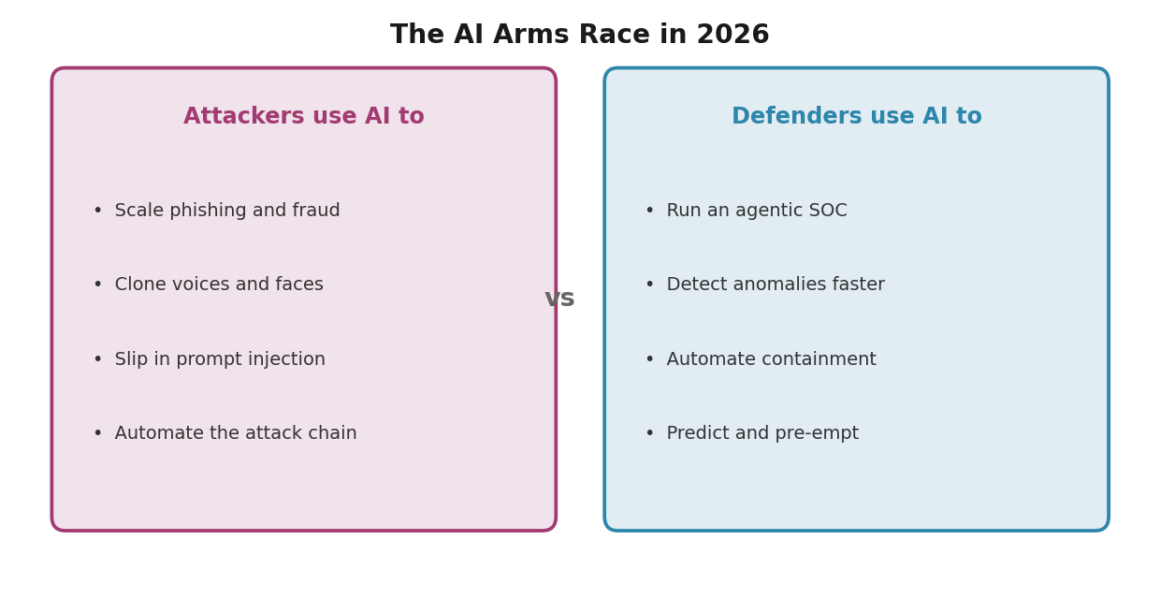
The same capabilities now sharpen both attack and defense.
Defenders are answering in kind, and many believe they hold the better hand because they can see the whole board. This is the same intelligence behind AI helping keep mobile apps secure, now scaled to entire enterprises. For a detailed view of how both sides are evolving, a leading 2026 threat forecast lays out the year ahead. What makes this race different from earlier ones is speed. When both attacker and defender move at machine pace, the edge swings to whoever automates the smartest response and keeps the cleanest data to learn from. The firms that pull ahead treat their own data as a strategic asset, not exhaust.
Trend 2: The Rise of the Agentic SOC
On defense, the headline shift is the agentic security operations center. Instead of analysts drowning in alerts, small, dedicated AI agents take on the grunt work: grouping alerts, summarizing incidents, drafting threat intelligence, and even starting remediation. Analysts move up a level, directing the agents and validating their calls.
The momentum is real. Gartner expects half of all threat-detection and response platforms to use agentic AI by 2028, up from fewer than one in ten in 2024. The aim is not to remove people but to scale their judgment, much as machine learning behind smarter apps amplifies what a small team can build. The catch is trust. An agent that acts on a wrong conclusion can cause harm quickly, so mature teams keep firm guardrails and require human sign-off before anything irreversible. The agentic SOC is powerful precisely because it is supervised, not unleashed.
“Organizations need to be prepared for threats and adversaries leveraging artificial intelligence.” Jon Ramsey, Google Cloud Security
Trends 3 and 4: Machine Identities and Shadow AI
As agents multiply, they open a new frontier: identity. Every autonomous agent acts inside systems, so each needs its own managed identity, permissions, and audit trail. Experts now expect non-human identities to outnumber human ones inside the enterprise, which upends how access is governed.
[Video: “The Future of Non-Human Identity” (BSidesLV): https://www.youtube.com/watch?v=sQSlAITPQpk]
This short talk explores why securing machine and agent identities is becoming a defining challenge.
The flip side is shadow AI. When employees deploy unapproved tools or agents, they create invisible pipelines that move sensitive data outside any policy, inviting leaks and compliance trouble.
|
Warning: banning AI tools rarely works; it simply pushes usage off the corporate network and removes all visibility. The safer path is to inventory every AI system and agent, then govern them like any other high-risk actor. |
For any regulated business, every agent that touches sensitive records is a potential exposure path, which is why identity and inventory sit at the top of the 2026 to-do list. Getting that groundwork right early is far cheaper than retrofitting it after an incident.
Trend 5: Governance, Readiness, and the Human Role
The final trend is a scramble to catch up. Regulations such as the EU AI Act, along with frameworks like the NIST AI Risk Management Framework and ISO 42001, are pushing organizations toward transparency and accountability, and executives are increasingly on the hook for AI risk.
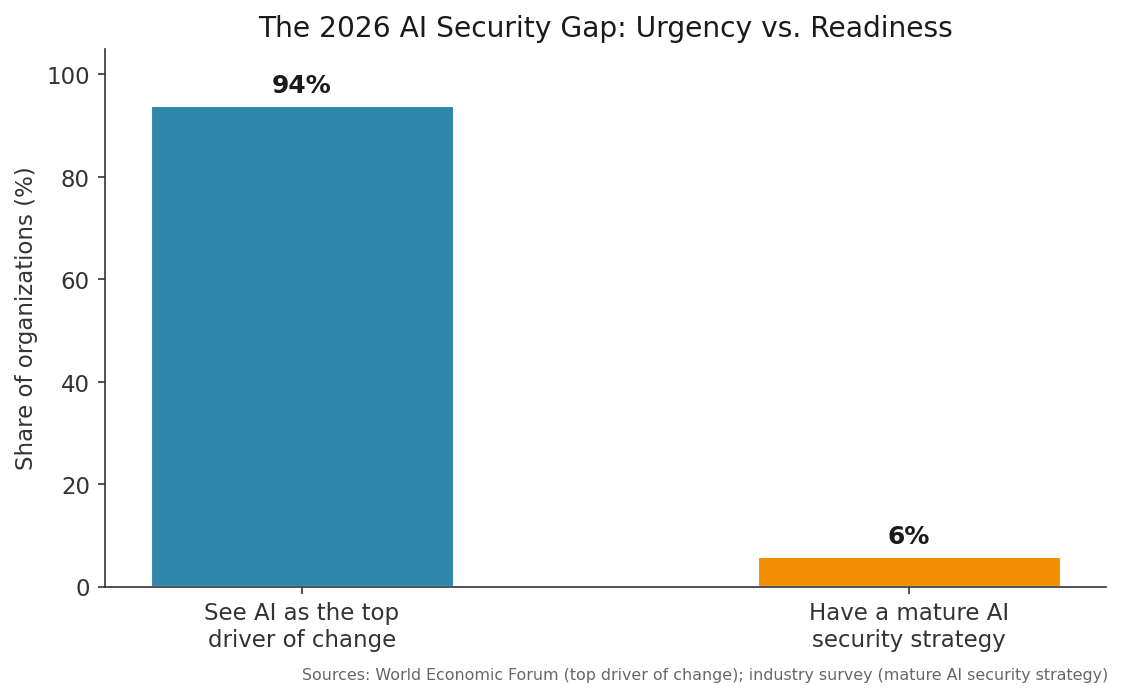
Urgency is nearly universal, but mature strategy is still rare.
The gap is stark. While almost everyone now calls AI the biggest force reshaping security, only a small minority have a mature AI security program in place. Closing that distance is the real work of the year. It is fast becoming a board-level concern, not just an IT one.
|
Priority |
Action |
|
Inventory |
Catalog every AI tool and agent in use |
|
Identity |
Extend access controls to machines and agents |
|
Governance |
Set a clear AI use policy with audit trails |
|
People |
Keep humans in charge of high-stakes calls |
|
Key stat: the payoff for getting this right is concrete. Organizations that use AI extensively in defense already save close to 1.9 million dollars per breach and contain incidents about 80 days faster. |
None of this removes the human role. Agents can make confident, damaging mistakes, so people still own the consequential decisions, backed by fundamentals like automated patch management and the kind of AI-driven security in mobile payments that keeps the basics solid. Put simply, the winning posture in 2026 blends fast machines with accountable people. Neither alone is enough, and automation without oversight invites the very incidents it was meant to prevent.
Frequently Asked Questions
What is the biggest AI trend in security for the year ahead?
The arms race between AI-powered attacks and AI-powered defense. Both sides now use AI routinely, so speed and automation increasingly decide who stays ahead.
What is an agentic SOC?
A security operations center where autonomous AI agents handle tasks like alert triage, investigation, and early response, while human analysts steer and check their work. That frees people to focus on the calls that need context and experience.
Why are AI agents an identity risk?
Each agent operates inside systems on someone’s behalf, so it needs a dedicated identity, scoped access, and an activity log. As agents multiply, machine identities can outnumber human ones and overwhelm older access models.
What is shadow AI?
Shadow AI is the use of unapproved AI tools or agents inside an organization. It creates invisible data pipelines that can leak sensitive information and breach compliance rules.
How should enterprises prepare for 2026?
Start with a full inventory of AI systems and agents, extend identity and access controls to them, set clear governance policy, and keep people accountable for the high-stakes decisions. Closing the readiness gap is the priority.
Preparation Beats Reaction
AI’s place in cyber security in 2026 is no longer a subplot; it is the main story. The technology powers faster attacks and faster defense, reshapes identity, and forces governance to grow up quickly. The pace is unlikely to slow, and the distance between leaders and laggards will only widen with it. The enterprises that thrive will not be the ones with the flashiest tools, but the ones that pair AI’s speed with clear policy, strong identity, and human judgment over the decisions that matter. The technology will keep accelerating on both sides, so preparing now, rather than reacting later, is what will separate the resilient from the exposed.
References
Google Cloud, Cybersecurity Forecast 2026. https://cloud.google.com/blog/topics/threat-intelligence/cybersecurity-forecast-2026/
World Economic Forum, Global Cybersecurity Outlook 2026. https://www.weforum.org/publications/global-cybersecurity-outlook-2026/
IBM, Cost of a Data Breach Report 2025. https://www.ibm.com/reports/data-breach
NIST, Artificial Intelligence Risk Management Framework (AI RMF 1.0), 2023. https://www.nist.gov/itl/ai-risk-management-framework
CSO Online, How AI Is Transforming Threat Detection (Gartner projections), 2026. https://www.csoonline.com/article/4154239/how-ai-is-transforming-threat-detection.html
Fact Check: All statistics and data points in this article were verified against original sources as of July 6, 2026. Sources are listed in the References section.